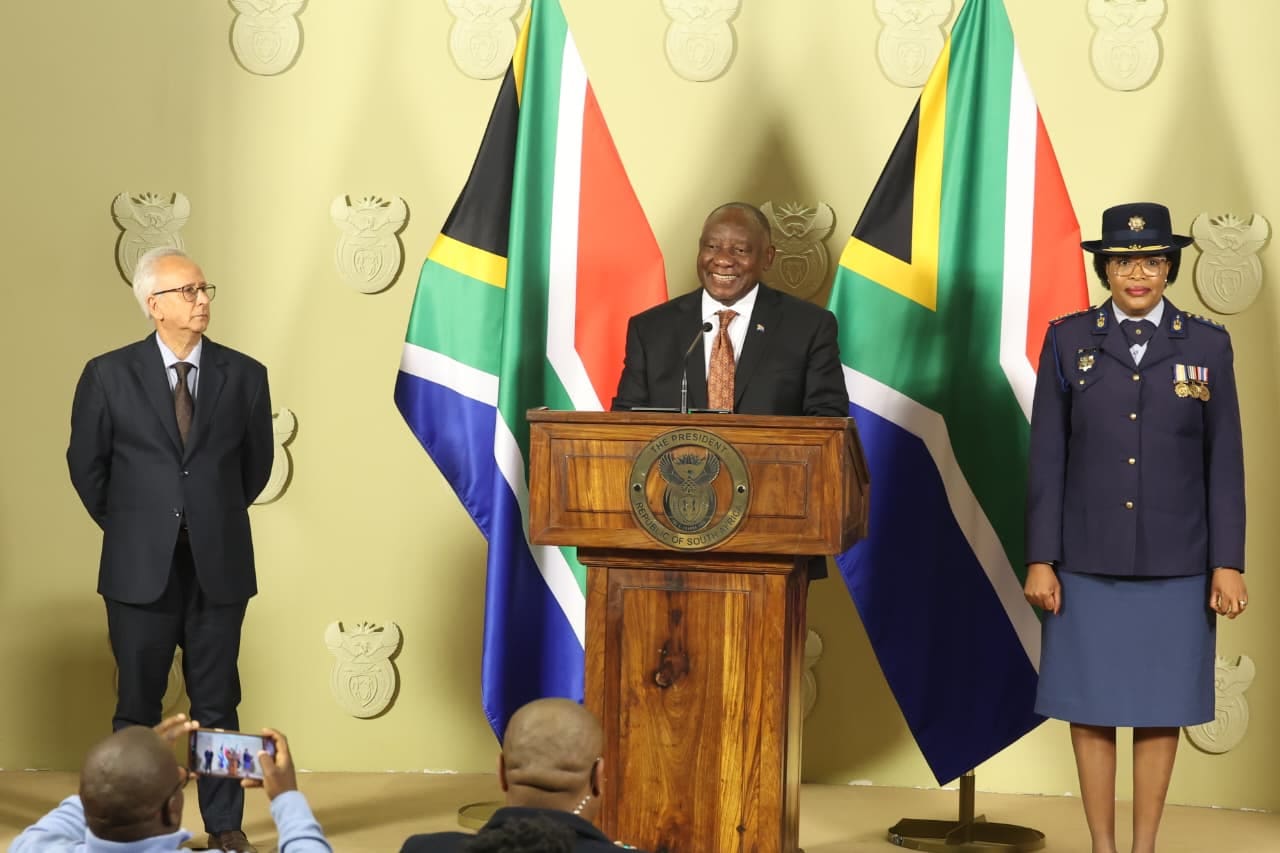
South Africa’s police got a new acting boss last week. The president appointed South African Police Services (SAPS) Chief Financial Officer Lieutenant-General Puleng Dimpane, passing over the public favourite, KwaZulu-Natal Provincial Commissioner Lieutenant-General Nhlanhla Mkhwanazi. It looks like a straight contest. But beneath the surface, it shows how politics continues to shape leadership decisions in South Africa’s critical institutions.
What just happened
Things moved quickly last week. On 23 April, President Cyril Ramaphosa placed National Police Commissioner General Fannie Masemola on precautionary suspension. This came two days after his appearance in the Pretoria Specialised Commercial Crimes Court, where he faces four counts of contravening the Public Finance Management Act (PFMA). At the centre of the case is the R360 million SAPS health services tender awarded to Medicare24, a company reportedly linked to alleged crime boss Vusimuzi “Cat” Matlala.
Big shake-up at SAPS 😬
— explain.co.za (@explainZA) April 24, 2026
Fannie Masemola has been placed on precautionary suspension after appearing in court this week. pic.twitter.com/3q9oa0K9DL
What is actually being decided
Most of the early commentary has framed the appointment as a binary choice: Dimpane as the “systems” candidate versus Mkhwanazi as the “street” candidate. It’s a neat way to tell the story. But according to Piers Pigou, director of Intel One, that framing puts the wrong question at the centre. “We have this unhealthy tendency to put our faith in the heroics of individuals to save the day,” he told /explain/. “This is more than individuals. This is about systems, processes, resourcing, strategy.”
For Willem Els, senior researcher at the Institute for Security Studies, Ramaphosa’s choice was less about reform than a way to avoid further fracturing a force already at war with itself. “Strategically, to take someone from a completely opposite side, who is not tainted by the operational challenges, was quite strategic,” Els told /explain/. “But it is also quite risky.”
Who are the two contenders?
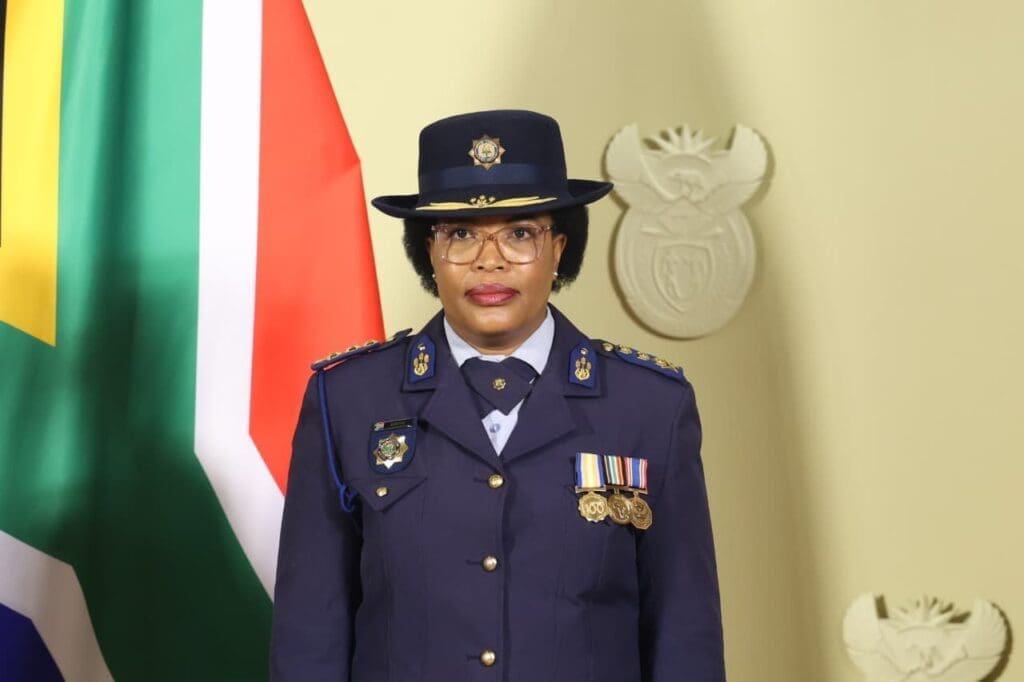
Lieutenant-General Puleng Dimpane. Credit: GovernmentZA/ X
Dipane and Mkhwanazi’s careers represent almost opposite paths through policing. Dimpane is not a career cop and has not been involved in frontline policing. She’s an accountant who joined SAPS in 2007 and has served as chief financial officer since 2018.
Earlier in 2025, she flagged irregular spending linked to the Medicare24 contract and halted payments by March. That same contract is now central to the charges facing Masemola. By November, she was testifying before Parliament, stating that, as chief financial officer, she had never been consulted on the disbanding of the Political Killings Task Team, a decision taken without her knowledge.
For Pigou, that puts Dimpane in a complicated position. On one hand, she is not personally implicated in the corruption that has seeped through parts of the police leadership. On the other “the absence of operational experience makes her perhaps a little more of a placeholder in this position”.
Then there’s Mkhwanazi, almost the exact opposite.
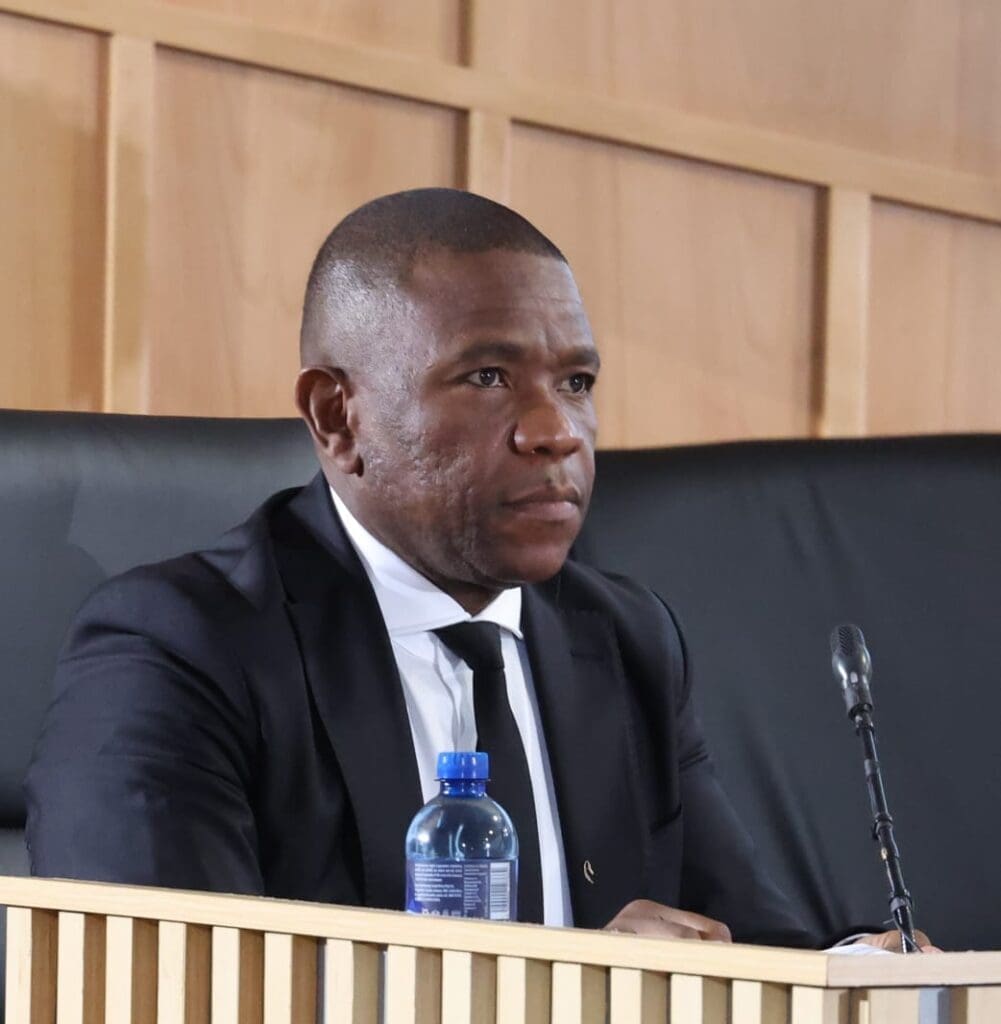
Nhlanhla Mkhwanazi. Credit: Commission of Inquiry Into Criminality, Political Interference and Corruption in the Criminal Justice System.
With 33 years at the SAPS, he has spent his career in the field. He has been the KwaZulu-Natal provincial commissioner since December 2018 and served briefly as acting national commissioner under then president Jacob Zuma between 2011 and 2012. Earlier this month, before his suspension, Masemola had tapped Mkhwanazi to lead a new national task team on organised crime.
But it’s not just experience that sets him apart. Since his July 2025 press conference, he has become a public symbol of accountability within the police.
Els puts the gap in public perception bluntly: “The trust of the public in Mkhwanazi is about 200% higher than that in the police.” He also points to outcomes. Under Mkhwanazi’s leadership, KwaZulu-Natal reportedly saw a roughly 9% drop in the murder rate during a period marked by a more aggressive, “no-nonsense” policing approach. “We’ve got more Mkhwanazis within the South African Police Service who are waiting to raise their hand,” Els adds.
The deciding factors
A few key factors tend to shape who ultimately gets the nod.
Service depth: This is the most obvious contrast. Mkhwanazi brings 33 years of experience, almost entirely on the operational side of policing. Dimpane has 19 years in SAPS, but largely outside frontline work. They are both “cops”, but in very different senses of the word.
Track record: Dimpane’s supporters point to her role in flagging irregularities in the Medicare24 contract, well before Masemola was charged, casting her as someone willing to challenge questionable decisions from within. But that same proximity raises questions. ActionSA SA MP Dereleen James argued that Dimpane “worked hand in glove” with Masemola and “should have been right next to him” in court. DA MP Ian Cameron has also questioned whether she has the operational grounding needed for the role.
Mkhwanazi’s record, meanwhile, is tied to his performance in KwaZulu-Natal and his public stance against alleged corruption. The latter is largely due to his July 2025 press conference, where he made explosive claims about a criminal syndicate operating within the SAPS, which led to the Madlanga Commission of Inquiry. But his claims still face scrutiny, particularly at the inquiry, where his evidence has yet to be tested under cross-examination.
Factional politics: Mkhwanazi’s claims have directly implicated Mchunu, a senior ANC figure aligned with Ramaphosa. That makes promoting Mkhwanazi politically costly, even if it might be popular with the public.
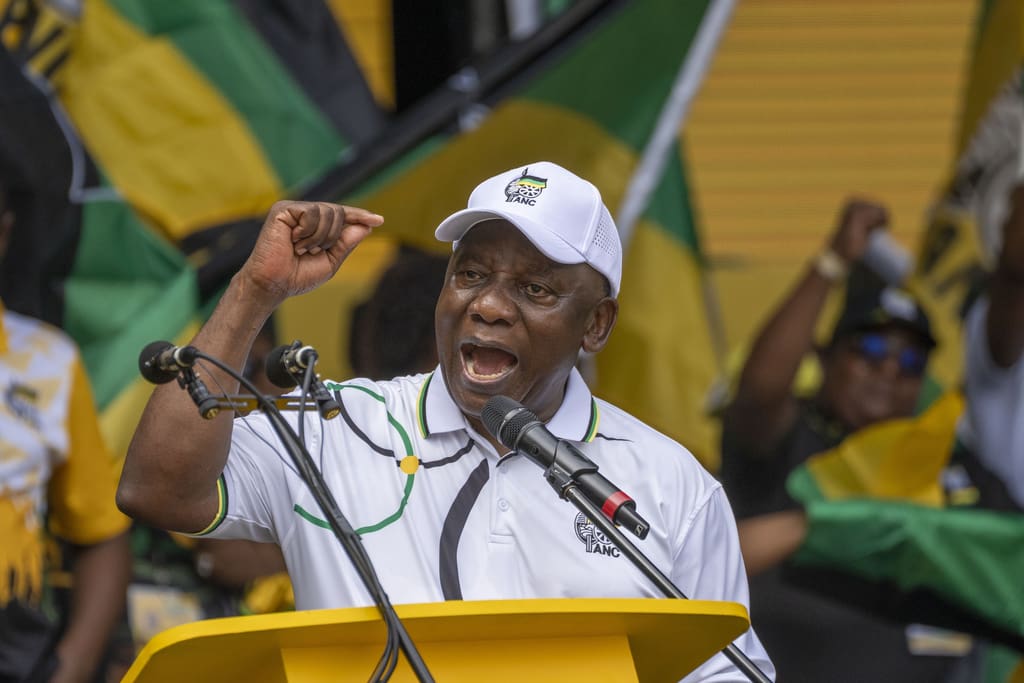
South African President Cyril Ramaphosa delivers his speech at the Moses Mabhida stadium in Durban, South Africa, Saturday, Feb. 24, 2024, during the African National Congress national manifesto launch in anticipation of the 2024 general elections. (AP Photo/Jerome Delay)
Dimpane, by contrast, carries far less visible factional freight. But that doesn’t mean her appointment is politically neutral. MK Party MP Nhlamulo Ndhlela criticised the move, saying it “reduces the problem of crime to just mere finance and the PFMA”, a signal that MK and radical economic transformation-aligned constituencies will not support a Dimpane confirmation.
Who is likely to ultimately land the position?
Els’s working theory is what he calls the “caretaker thesis”. “Normally, when they appoint a caretaker in this position, they don’t normally make a lot of decisive decisions. They sort of ride it out, stabilise, and hand over to the new incoming person that has been permanently appointed,” he said.
On that reading, Dimpane isn’t necessarily the long-term answer to SAPS’ leadership crisis.
That brings Mkhwanazi back into the picture. He has two things going for him that are hard to ignore: public sentiment and credibility. Since his initial claims about corruption in the SAPS, he has built a reputation for confronting corruption within the system. If the Madlanga Commission’s interim report lands heavily against Mchunu, the political equation changes. Backing Mkhwanazi, which looks risky today, could quickly become the safer option.
What happens next
There are three key dates that will shape what happens next, and importantly, all of them land before any realistic permanent appointment can be made. First, on 13 May, Masemola returns to court for the next stage of the PFMA case. That process will continue to test the details around the Medicare24 contract and keep pressure on the broader leadership question inside SAPS.
Then, on 29 May, the Madlanga Commission releases its second interim report. Depending on how strongly it speaks to allegations involving senior figures like Mchunu, it could influence any future appointment. And on 31 August, the commission delivers its final report, which will also have political implications.
The bigger picture
Both analysts end up in the same place: it’s not really about either contender, it’s about the people around them. Pigou says, “Watch much more closely the key people around her [Dimpane]. If it is the same bunch of people that were around Masemola, are we going to really see a significant difference?” Els makes the same point: “It will really be very, very important that she surrounds herself with the right people now.”
For Pigou, the real news is not so much who will be the top cop, but the wider institutional failure. “This is a broken police force that needs inspiration.”
He points to what that looks like on the ground. During a recent late-night visit to a township station, there was only one vehicle covering the entire community. “The people [police] have to buy their own boots.”
The most useful question isn’t who deserves the job. It’s whether anything meaningfully changes once they’re in it.