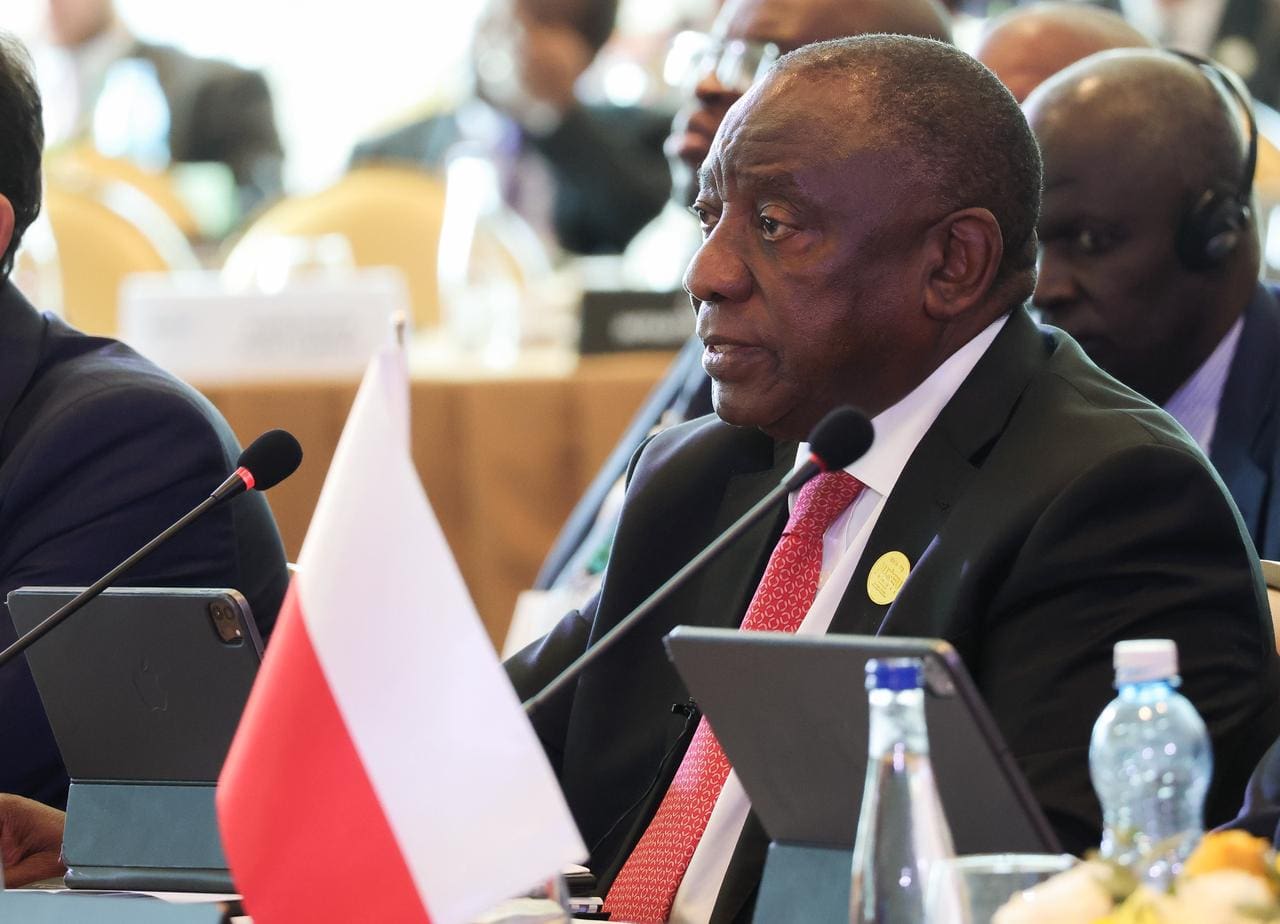
Last week France withdrew South Africa’s invitation to the G7 summit in Evian in June. But why did the French remove us from the G7 WhatsApp group and what are the implications?
South Africa is not a G7 country, but had been expected to attend this year’s summit after French President Emmanuel Macron invited President Cyril Ramaphosa last year when they met at the G20 in November.
Presidential spokesperson Vincent Magwena told News24 the decision was because of intense pressure from the US. He said the French Embassy told the Presidency that the US threatened to boycott the summit should South Africa attend.
This isn’t surprising: Remember how the US boycotted last year’s G20 summit in Johannesburg? And US President Donald Trump has already uninvited South Africa from this year’s G20 summit in Miami in December. It’s safe to say we’re not on the United States’ Christmas card list.
Meanwhile, French Foreign Affairs Minister Jean-Noël Barrot has denied US influence was behind the decision. That’s what diplomacy’s all about, but we’re not sure we buy it.
Professor John Stremlau, a visiting professor at the University of the Witwatersrand told /explain/ the US’s involvement in the situation is undeniable. He views it as a direct response to South Africa’s stance on multiple conflicts and wars, including Israel-Palestine, Russia-Ukraine, and US-Israel-Iran.
For his part, Dr Thapelo Tselapedi, a senior lecturer in the University of the Western Cape political studies department, explained G7 and G20 are largely about getting different countries on the same page.
But if French Macron’s warnings from last year’s G20 are anything to go by, divisions will remain deep, particularly on global conflicts and climate policy, even with South Africa absent from the negotiating table.
So where does that leave South Africa’s G20 objectives for peace and equality, sustainability and the just energy transition, and inclusive economic growth and fair trade?
We bring you the breakdown of what South Africa’s disinvitation means for our biggest priorities.
Peace and multilateralism
South Africa’s experience with transitioning to democracy after apartheid gives it credibility in promoting negotiation amid rising geopolitical tensions and the wars in the Middle East. But, as Stremlau noted: “Trump is not a multilateralist. He didn’t even consult the Europeans and Nato allies before he started bombing Iran.”
Tselapedi pointed out that G7 is a platform for the West: its members are Canada, France, Germany, Italy, Japan, the United Kingdom and the US. “South Africa’s absence from the G7 and its agenda around peace over violence will not necessarily be sidetracked – it’s just going to be seen through the perspective of regional superpowers, such as the US,” Tselapedi said. “This is against the multilateralism that South Africa and the Global South is trying to advance.”
Sustainability and climate action
South Africa’s G20 objectives emphasised the just energy transition – moving towards greener energy in a collaborative manner.
But Saliem Fakir, the executive director of the African Climate Foundation, noted that the just energy transition last made it into the G7 Leaders’ Declaration in 2023 under Japan. It did not appear under Italy in 2024 or Canada in 2025.
“Canada could not even get a consensus Leaders’ Declaration,” Fakir said. “The inclusion of the ‘just’ part of the energy transitions is not a given, irrespective of whether South Africa is a part of G7 or not.”
Much like Tselapedi, Fakir expects the agenda will be driven by a Western-centric approach. “We are mindful of the severe implications that the war in Iran is having on energy security, but we also share the concern that a lot of South Africa’s priorities on climate resilience and energy transitions will be sidelined,” he said.
Inclusive economic growth
Tselapedi said fair trade is hitting a wall. He notes that the US is pivoting towards a transactional relationship with Africa, with USAID and the Agoa trade-preference programme being used as leverage.
“The US’s new strategy for Africa is essentially about exchanging aid for trade,” Tsalapedi said. “Because of this, we’re seeing instances where the US is saying: If you want this aid, we want these minerals in exchange.”
Should South Africa care about the G7?
Tselapedi and Fakir both said the G7 is facing an identity crisis.
“I think the G7 is putting up a brave front of togetherness, but perhaps the world has changed so fast that the question of what the G7 is in the current context is going to be the important issue,” Fakir said.
Tselapedi noted that, in the past, South Africa’s voice carried weight in Western forms. In his view, these days the West seems more interested in creating an echo chamber than engaging in democratic debate.
“The bigger loss for us is that South Africa was also uninvited from G20 this year, [although] we are a full member,” Fakir said. “I think we need to rather focus on the arenas which we are part of, like Brics.”