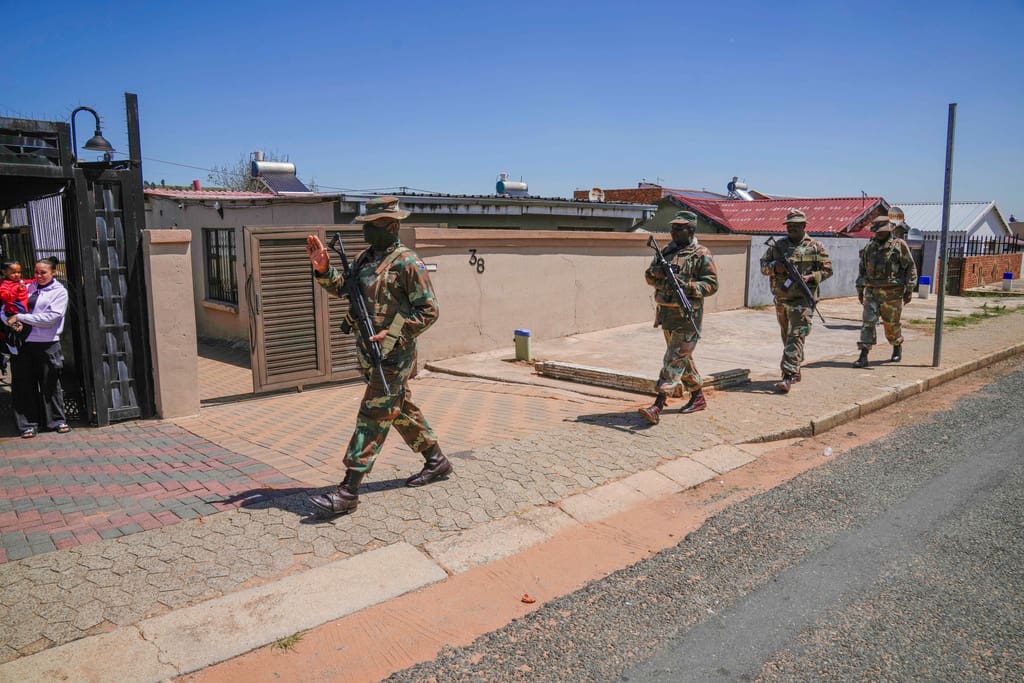
South Africa has once again turned to its military to help to fight crime, deploying 2,200 soldiers into communities affected by gang violence, illegal mining, and organised criminal networks.
The deployment, authorised by President Cyril Ramaphosa, will run from the beginning of March this year to the end of March next year across five provinces: Gauteng, the North West, the FreeState, the Western Cape and the Eastern Cape.
The government has framed the move as a necessary intervention, but it raises a deeper question: What does it mean when the police can no longer manage crime on their own?
A military response to a civilian problem
The South African National Defence Force (SANDF) is not replacing the police, but supporting South African Police Service (SAPS) operations in identified hotspots. Their role includes patrols, assisting with raids, and targeting illegal mining operations, which authorities say are increasingly linked to organised crime.
Police leadership has described the intervention as a way to “stabilise” volatile areas. But researchers warn that soldiers and police serve fundamentally different functions. Martin Hood, a legal expert specialising in firearms law, licensing, and regulation, says: “Of greater concern is that the SANDF is not trained in civilian law enforcement. Soldiers are not equipped to enforce criminal procedure, collect and preserve evidence, or handle suspects.”
Analysis by the Institute for Security Studies (ISS) notes a structural mismatch between military training and civilian policing. Soldiers are trained to neutralise threats, whereas police are required to operate within strict constitutional limits, using force only when necessary and proportionate, while preserving evidence and protecting life. “Soldiers and police are not interchangeable,” the ISS researchers warn, noting that poorly managed deployments risk undermining public trust.
Short-term stability, long-term uncertainty
Crime experts say the deployment may bring temporary relief, but is unlikely to resolve the underlying drivers of violence. The head of the ISS justice and violence-prevention programme, Lizette Lancaster, describes the use of the military as a “force multiplier” intended to stabilise areas experiencing high levels of violence. “These interventions can create temporary stability. People feel safer when there is a visible state presence,” she said. But she warns the effect does not last. “The groups don’t disappear. They retreat from public space and return once the deployment ends.”
This aligns with ISS research, which finds enforcement surges can suppress violence in the short term, but rarely produce sustained reductions. “Enforcement alone doesn’t change the conditions that allow organised crime and gangsterism to persist,” the researchers note.
In Randfontein, Dianne Hawker reports for DW News that some residents say the military presence is making a difference, particularly given the illegal mining in the area. Illegal mining is estimated to cost South Africa about R70 billion a year in lost revenue.
For directly affected communities, the stakes are immediate. Randfontein resident Thabi Lebididi said: “At night, our work is not safe.” Lebididi and other residents say they welcome the SANDF deployment in the area. But critics warn that visible impact on the ground may come at a longer-term cost.
A sign of deeper systemic strain
Hood said deploying the military risked masking deeper failures within policing. “Deploying the army does not address the fundamental, long-term deficiencies within the South African Police Service. The police service is, in many respects, unable to fulfil its constitutional mandate,” Hood said. “Ultimately, this approach risks papering over the structural problems within a dysfunctional police system, rather than fixing them.”
Violence researcher Mary de Haas argues that deeper systemic failures within policing structures may be driving the need for military intervention, pointing to concerns about the effectiveness of crime intelligence and police management.
De Haas also pointed to what she sees as a shift in government approach, noting that previous calls for military support in violence-affected rural areas were resisted, whereas similar deployments are now being authorised.
South Africa continues to face extremely high levels of violent crime. Police data shows that 6,351 people were murdered between October and December 2025, an average of 71 killings a day. Firearms remain a central driver, with nearly half of all murders involving guns.
Similar military deployments have taken place before, including in gang-affected areas and during periods of unrest, but the scale and duration of the current operation suggest a more entrenched crisis.
When criminal networks replace the state
In some communities, criminal groups have become embedded in everyday life. “Unless you disrupt [these networks] properly, they continue to operate and often grow,” Lancaster said.
She added that in certain areas, gangs provide services that the state fails to deliver. “In some communities, gangs provide food, loans and a form of protection. They start to function as a kind of alternative governance.”
This dynamic complicates enforcement efforts, as criminal groups are not only perpetrators of violence, but also part of the local social and economic fabric.
The risk of blurred lines
The deployment also raises concerns about oversight and accountability. Military deployments in civilian spaces carry risks if not carefully managed. ISS research highlights that unclear command structures, rules of engagement, and accountability mechanisms can increase the likelihood of excessive force and erode public trust.
South Africa has already experienced such risks. During the Covid-19 lockdown, there were widespread reports of excessive force involving both SANDF and SAPS personnel.
Analysts warn that repeated reliance on military deployments risks normalising the use of the army in civilian policing roles, blurring constitutional boundaries between defence and law enforcement.
Illegal firearms and the cycle of violence
The availability of illegal firearms remains a key driver of violent crime. Lancaster points to police data showing that, on average, about 22 firearms are lost or stolen every day in South Africa, including from state institutions. “Most illegal firearms start off as legal guns,” she said.
She noted a shift in how firearms are distributed within criminal networks.“Fifteen years ago, firearms were mostly in the hands of senior gang members. Now even lower-level members have access.”
ISS research emphasises that removing illegal firearms from circulation is critical to reducing violence, but requires coordinated, intelligence-led policing rather than broad enforcement surges.
A temporary fix for a structural problem
The government has positioned the deployment as part of a broader strategy to combat organised crime.
But analysts argue that the use of the military reflects a wider pattern: treating violence as a series of crises rather than a long-term governance challenge. Hood says: “Using the army is not a sustainable solution. If anything, it delays urgently needed reforms within SAPS. It may even create a false sense of success if crime temporarily declines in areas where the military is deployed. But once that deployment ends, crime is likely to return to previous levels.”
Success, the ISS researchers argue, should not be measured by short-term declines in crime during the deployment, but by whether those gains are sustained after soldiers withdraw.
For now, the presence of soldiers on South Africa’s streets reflects both the urgency of the country’s crime crisis and the limits of the state’s response. But without deeper reforms to policing, intelligence, and firearms control, the cycle is likely to repeat.

Catherine White is an independent South African journalist and producer with experience reporting internationally. Her work focuses on investigative reporting, accountability journalism and explanatory storytelling that unpacks complex issues.