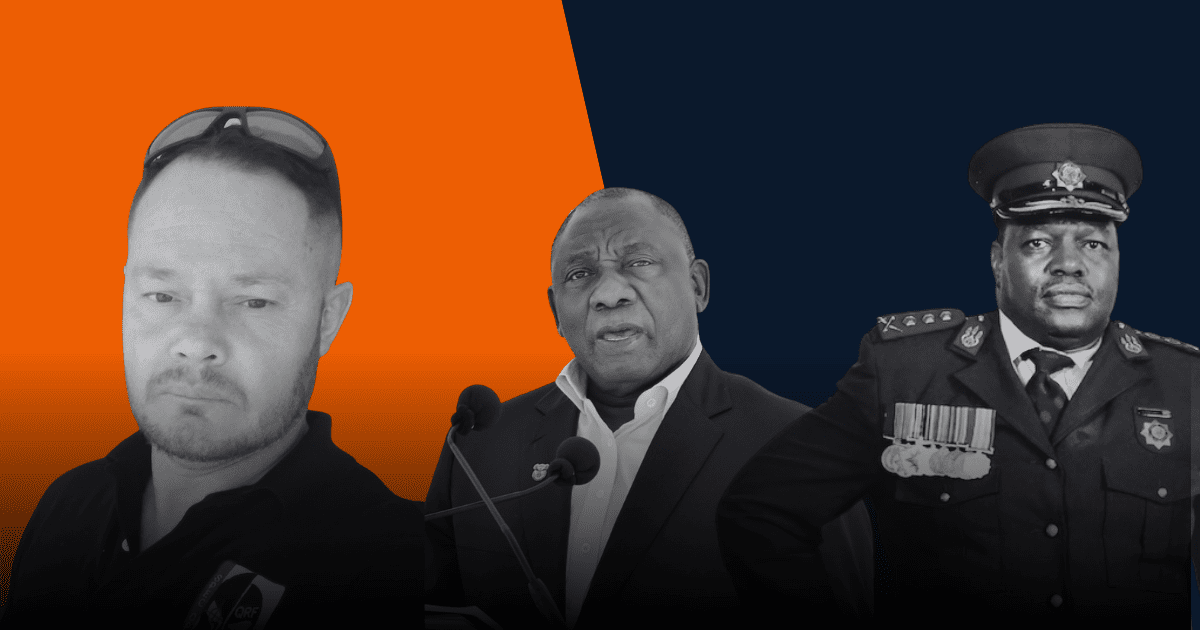
On Friday evening, outside his home in Brakpan, the man known to South Africa as “Witness D” was gunned down in full view of his wife.
Less than a month earlier, Marius van der Merwe stood before the Madlanga Commission, giving damning testimony about corruption and cover-ups within law enforcement.
His killing is being widely condemned by politicians and members of the South African Police Service (SAPS) alike, as an “attack on justice”.
Yet the condemnation feels hollow, coming from institutions that were not only meant to protect him but in some cases were the very structures he was testifying against. His assassination is already doing exactly what his killers intended by scaring other whistleblowers into silence.
RECAP: What is the Madlanga Commission?
The Madlanga commission has been widely covered in South African media over the last three months.
And for good reason: The Judicial Commission of Inquiry into Criminality, Political Interference, and Corruption in the Criminal Justice System was set up in July with the intention of sifting through allegations of corruption, criminality and political interference within the country’s policing and justice systems.
Through a series of testimonies and interrogations, the commission has uncovered a web of “state capture 2.0,” where criminal syndicates (like the Big 5 ) allegedly collude with officials to control illegal mining, tender fraud, and assassinations.
Read our full explainer on the Madlanga Commission here.
Who was Witness D?
In November, Van der Merwe, a former Ekurhuleni Metropolitan Police Department (EMPD) officer turned private security firm owner, testified as “Witness D” before the Commission of Inquiry.
Throughout his testimony, he detailed a 2022 EMPD operation in Brakpan, aimed at retrieving a stolen truck and warehouse stock from a robbery. Van der Merwe alleged he arrived alone to find a mix of law enforcement and security personnel already on site. During interrogation, the robbery suspect was suffocated with a plastic bag in a method known as “tubing,” a form of torture synonymous with apartheid-era brutality. The suspect died during interrogation.
What followed was a frantic cover-up: senior EMPD official Julius Mkhwanazi arrived at the scene and allegedly ordered that the body be disposed of and instructed officers to ‘clean up’ evidence.Van der Merwe said he was forced to drive the corpse to a nearby dam, where it was dumped.
His testimony painted a picture of state-sanctioned brutality and a calculated effort by police to hide an unlawful killing. The Independent Police Investigative Directorate has been investigating the matter since 2022.
What is the nature (and danger) of Whistleblowers?
By definition, whistleblowers are insiders (often employees or former employees) who expose wrongdoing: corruption, illegal acts, cover-ups, abuse of power.
In South Africa, whistleblowers have, time and again, helped unearth corruption scandals, often at great personal cost.
- Babita Deokaran, a corruption whistleblower in the Gauteng Department of Health, exposed R850 million in corrupt tenders at Tembisa Hospital, only to be assassinated in a daylight hit in 2021.
- Jimmy Mohlala, Mbombela stadium project manager during the 2010 World Cup preparations, exposed massive tender corruption and overpricing, and was assassinated at his Nelspruit home in 2009.
- Cloete Murray, a seasoned liquidator investigating Gupta-linked corruption, was murdered along with his son in a highway ambush in 2023.
These are sadly only a few examples of the dozens of South African whistleblowers who have paid with their lives for daring to speak the truth. Many others have faced ostracism or job loss.
Mandy Wiener, journalist and author of The Whistleblowers, says this pattern is not new.
She told explain that while the motive for Van der Merwe’s assassination isn’t confirmed, “we have seen a pattern in South Africa of targeted assassinations of whistleblowers or witnesses or anybody who could be exposing wrongdoing. The cost of life is so cheap, and we see these hits being carried out far too often and far too easily and without any consequence.”
She adds that the problem extends beyond policing alone: “When it is about the police, then it is extremely concerning. But it’s also more prevalent. We’ve seen the assassination of investigators, we’ve seen the assassination of police officers… that’s a real red flag”.
Political parties, civil society groups and anti-corruption watchdogs have all issued the same warning: unless whistleblower protections are dramatically strengthened, the next van der Merwe may simply choose silence. This is exactly what his killers intended.
What is the legal framework for whistleblower and witness protection — and its gaps?
South Africa does have laws intended to protect whistleblowers and witnesses, but as Marius van der Merwe’s tragic assassination shows, the system has obvious flaws.
The Protected Disclosures Act of 2000 aims to foster a “culture of openness and accountability” by shielding those who report improprieties.
It outlines procedures: disclosures to employers, regulators, or law enforcement, with protections against retaliation like dismissal or demotion. The government is mandated to promote compliance, investigate claims, and remedy harms.
For high-risk cases, the Witness Protection Act of 1998 established the Office for Witness Protection under the National Prosecuting Authority (NPA).
Dr Liezl Groenewald, Co-founder of The Whistleblower House, and CEO of The Ethics Institute, told explain that the Witness Protection Act provides several mechanisms for safeguarding witnesses:
- Section 7(1)(a)(iv) allows a witness who feels unsafe to request protection by reporting their concerns to an investigating officer, SAPS, or a body such as a commission, before testifying.
- Section 7(1)(2)(s) goes further, allowing an “interested functionary”, for example, the head of a commission, to report concerns on behalf of a witness.
- Once reported, the Director of the Office for Witness Protection has the authority to place a witness under protection. “The Director is empowered to order that a witness be placed under protection”.
“In relation to this final provision, both the law and the Commission failed Mr van der Merwe,” said Dr Groenewald.
Wiener agrees that the system is fundamentally flawed. “It doesn’t work the way things currently are. The only way to get protection is if you’re a witness in a criminal case. If you’re a whistleblower, you’re not entitled to protection,” she said. And even when whistleblowers are given access to the witness protection programme, “[it] requires you to give up your identity, and your life. And that’s not sustainable”.
In an ideal system, she said, “the moment Mr van der Merwe left the Commission chamber a competent system would have placed him under automatic, state-initiated protection and not left the decision to him, not waited for a personal request, and certainly not allowed him to rely solely on a private security provider (albeit his own company).”
“The Commission and the Witness Protection Office had both the authority and the responsibility to act pre-emptively, and that should have happened immediately.” That did not happen, and that failure cost him his life.
Using a pseudonym, like “Witness D,” is also a weak shield. According to Dr Groenewald, “Pseudonyms are routinely used in Commissions and investigative inquiries… But in organised crime or corruption cases, perpetrators often know exactly who testified long before the public does. Thus, a pseudonym protects the record, but definitely not the person, as was the case with Witness D/Mr van der Merwe.”
What comes next?
In the immediate wake, the Madlanga Commission and National Joint Operational and Intelligence Structure convened an emergency meeting, announcing heightened protection for all remaining witnesses, enhanced risk assessments, and 24/7 monitoring for those linked to the inquiry.
National Police Commissioner General Fannie Masemola confirmed three persons of interest have been identified and vowed a breakthrough in the probe, treating it as a “priority crime” tied to organised networks.
Dr Groenewald told explain that the single most important reform is “to establish an independent, rapid-response whistleblower protection agency with legal and operational autonomy from law enforcement agencies and the political executive, dedicated solely to safeguarding witnesses and whistleblowers.”
“South Africa’s current systems (Hawks, SAPS witness protection, the Protected Disclosures Act) are fragmented, slow, under-resourced, and, critically, not trusted by the very people who need protection,” she said.
“We have seen that many whistleblowers report threats, are ignored, or are placed into systems compromised by the same networks they are exposing,” said Groenewald.
“A standalone, independent agency that is insulated from political influence and corruption networks, would allow the actual protection of lives before threats escalate to assassinations”.
Wiener agrees that any meaningful reform must include a protection body completely independent of the NPA and SAPS. “I have long advocated for a Chapter 9 organisation…a standalone, one-stop shop for whistleblowers, where they are offered psychological, financial, legal and physical protection,” she said.Justice Minister Mmamoloko Kubayi revealed on 6 December that her department has finalised the Protected Disclosures Bill, now undergoing cabinet vetting, which would extend safeguards beyond court-bound witnesses to all whistleblowers.
As Weiner put it: “there’s no way that you’re going to encourage witnesses or whistleblowers to come forward if they’re being killed. We need better legislation in place, we need better structures in place. We need a societal revolution in how people talk about whistleblowers”.
explain reached out to the National Prosecuting Authority (NPA) for comment, but did not receive a response by the time of publication.

Emma is a freshly graduated Journalist from Stellenbosch University, who also holds an Honours in history. She joined the explain team, eager to provide thorough and truthful information and connect with her generation.